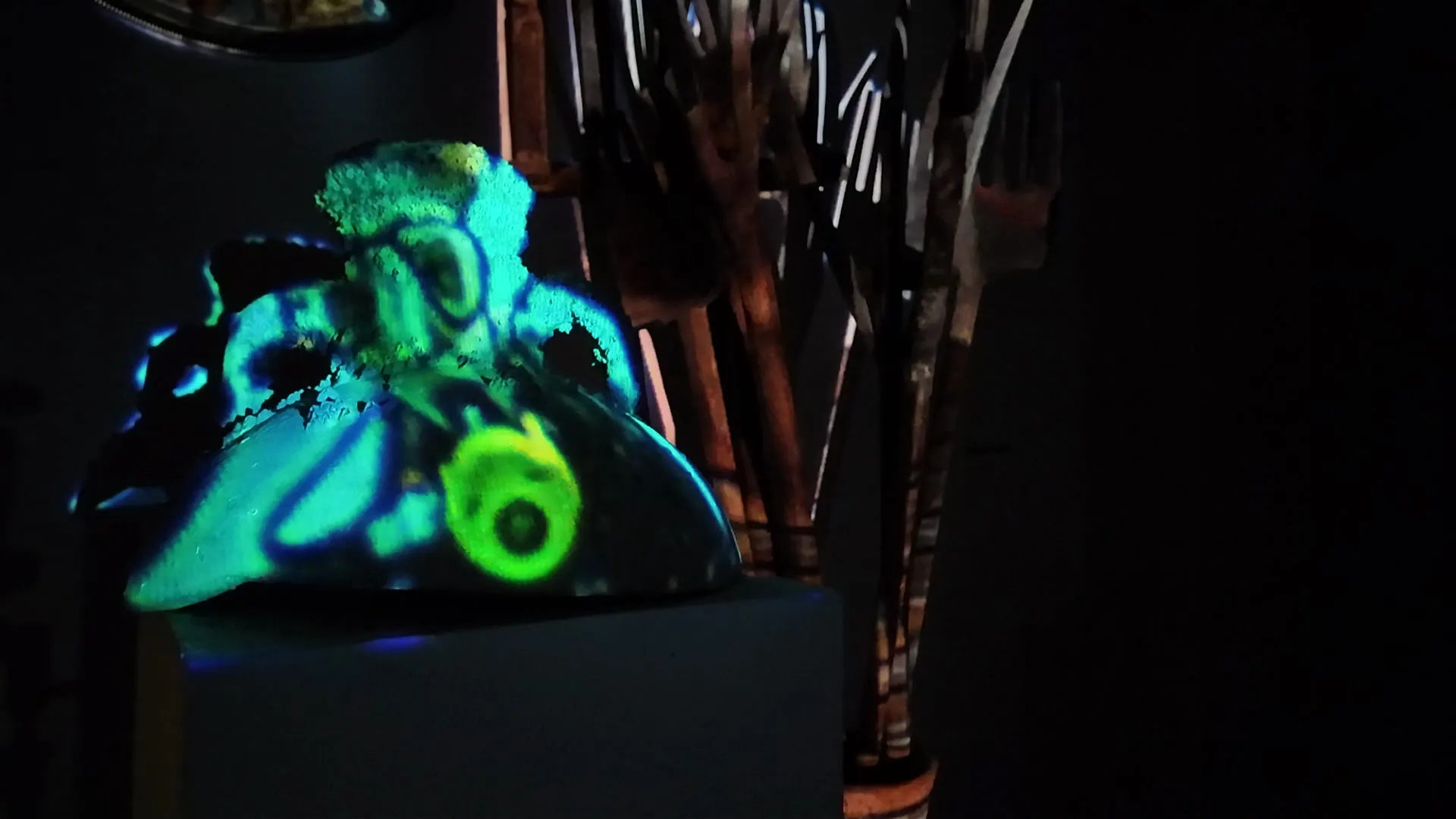
Schnuckelchen, 2026
Video Installation, 2026
Four-channel video projection, a Roman amphora recovered from the sea and covered in barnacles, an antique Edwardian serving tray, Morag (Hebrew for a traditional threshing sledge), vintage wooden winnowing forks and pitchforks, an antique hand-painted earthenware jar, pedestal, sound
Schnuckelchen projects footage from one family’s archive onto objects it has kept across more than three generations. Four channels run at once.
In Hebrew, Morag names a threshing sledge, a wooden board studded with blades, and dragged over harvested grain to separate wheat from chaff. The artist’s grandfather, an agricultural biologist whose research focused on how sheep and cattle could adapt to desert conditions, chose Morag as the family’s new surname, as part of adapting to a new language and country after immigrating. Footage of the artist’s younger sibling loops across the Morag.
In the 1930s, as Nazi rule took hold in Germany, the family left Hamburg. They were Jewish, and among what they carried out of the country was a wooden serving tray that has passed through generations in the family. It now carries footage of a birthday recorded decades later, in the backyard they eventually settled into.
In that same backyard, about twenty years later, two siblings, no older than ten, dance for the camera. The wooden winnowing forks and pitchforks now carrying that footage are the same objects visible in the background of both recordings, the birthday and the dancing. The artist’s father collected them across the Middle East over decades, long before they stood in that yard and were brought into this room. They stand gathered inside a large earthenware jar, hand-painted in reddish geometric patterns that echo far older Canaanite pottery. Made around 1850, it belongs to a style found across potters’ traditions from North Africa to Anatolia. The jar itself also appears in that same footage, barely visible in the background.
A Roman amphora, once used to ship wine or oil across the Mediterranean nearly two thousand years ago, was recovered from the seabed by the artist’s uncle while diving. Its neck still carries centuries of barnacle growth. The footage projected onto its surface shows an entirely different sea, not far from the Mediterranean, the artist’s own brother diving with dolphins in the Red Sea.
The sound accumulates. One channel joins another until the room fills with an overlap of diving, voices, and celebration. Together they form the installation’s soundtrack, each preserving the original, unedited sound recorded with its video. As a viewer moves toward one object, its sound briefly comes forward before settling back into the whole.